Sustainability Policy

The Nippon Paint Group will aim to create wealth by addressing social issues with the goal of achieving Maximization of Shareholder Value (MSV).

Materiality

Sustainability as the Prerequisite for MSV

Sustainability based on Materiality

We believe that fulfilling our obligations to customers, suppliers, employees, society and other stakeholders is the premise for all initiatives for the maximization of EPS and PER.
We use a medium- to long-term perspective for monitoring a broad range of risks and opportunities involving Materiality. At the same time, we are working to turn these risks and opportunities to creating innovations that support growth strategies based on our Asset Assembler model while watching for changes in Materiality. By taking these actions, we pursue MSV by expanding earnings (maximizing EPS) and raising market expectations (maximizing PER) for Nippon Paint Group.

Materiality identification process

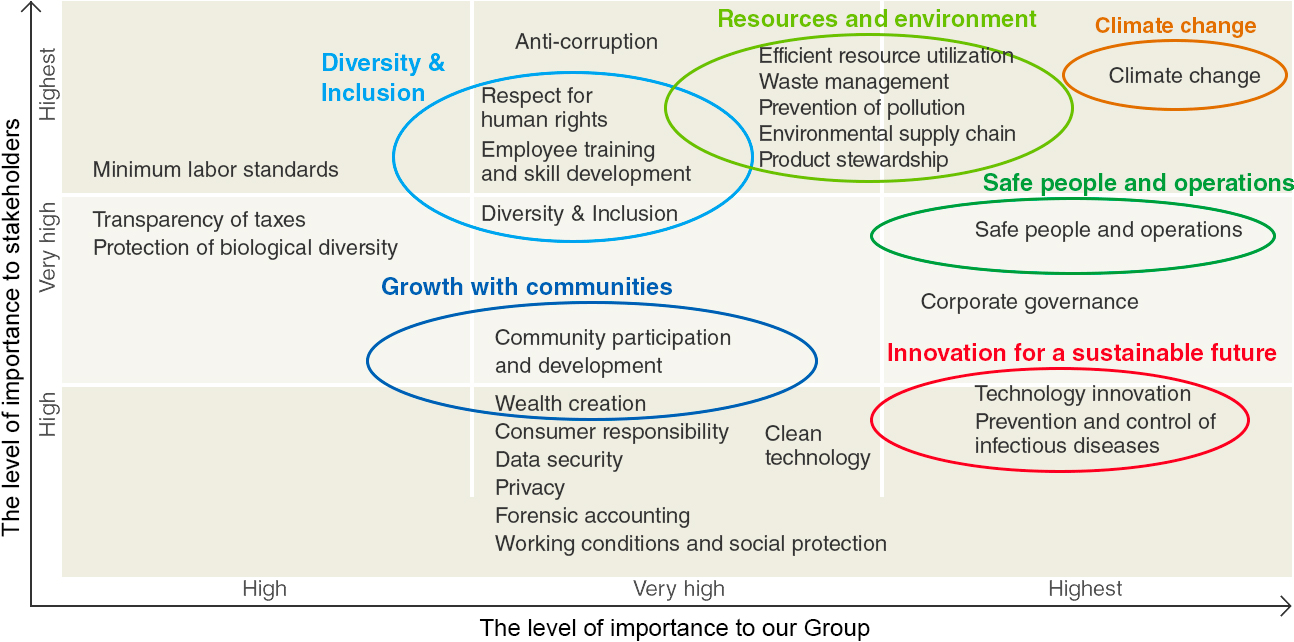
In identifying Materiality, we listed the important issues required by society with reference to international ESG guidelines such as GRI and SASB, as well as items required by ESG research organizations. We then quantitatively assessed these issues from two perspectives: “importance to stakeholders” and “importance to Nippon Paint Group,” and verified their level of importance. We also incorporated objective perspectives through dialogue with external experts, discussed the issues with partner companies in Japan and overseas, extracted important issues in light of our business model and operating environment, and identified them as Materiality.

Sustainability
Materiality (key issues)
Management model “Asset Assembler”
Maximization of Shareholder Value (MSV)

* For information on the ESG management structure, please see here.

Preliminary
list
  • We created a long list of 75 items that is our obligation to address based on international ESG standards and guidelines for disclosure and reporting derived from 11 ESG rating agencies and organizations. We then consolidated the list down to a preliminary list of 32 items.
Stakeholder opinions
Internal
questionnaire
  • The newly-established then ESG Committee met in April 2020 and deliberated on the materiality identification process. Also, we distributed a questionnaire to the 25 committee members and the staff of the then ESG Promotion Department for their input on the items in the preliminary list.
Incorporating
global risks
  • To incorporate global risks, the discussions also included chemical sector risk scenarios based on information in the Vigeo EIRIS Controversy Risk Assessment and other reports. Peer companies in the global chemical sector and forward-thinking Japanese companies were also referred to.
Internal
discussion
  • Based on the weighting of importance for stakeholders and for Nippon Paint Group we identified six groups of items of materiality for business sustainability. During the process, we placed particular importance on discussion and agreement with overseas partner companies.
Internal discussion
Stakeholder
opinion
  • We interviewed various stakeholders and Independent Directors to gather their opinions on the potential items of materiality and created the final proposal through internal discussion.
Stakeholder opinions
Approval
  • We deliberated on the final proposal at the then ESG Committee meeting in July 2020 and obtained final approval at the Board of Directors meeting in August.
Internal discussion

Materiality Map

Materiality Map

Materiality and Relevant SDGs

Updated on June 30, 2026

TeamOur pursuitMaterialityRelevant SDGs

Environment &
Safety

Develop low-carbon/
eco-friendly products
+
Ensure safe people
and operations

Climate change
Climate change is impacting our business, people, and communities. We will work to reduce our greenhouse gas emissions, manage climate-related risks, and capture climate-related opportunities.

Resources and environment
Our business and communities depend on the sustainable consumption of natural resources and protection of the environment and biodiversity. We will work to improve the life cycle and circularity impacts of our products and supply chain.

Safe people and operations
There are significant safety and health risks in our business that could impact our people, supply chain, and communities. We will work to manage these risks effectively and prevent harm, with a priority focus on high-consequence risks.

People &
Community

Recruit/train
diverse employees
+
Earn the trust
of stakeholders

Diversity & Inclusion
Respect for the people around us, respect for human rights and active acceptance of diverse values are important for our sustainable growth. We value diversity of ideas and thinking to foster innovation and growth.

Growth with communities
We will invest in communities through our value chain and achieve sustainable business growth based on market growth, brand strengthening and good relationships with local communities.

Innovation &
Product Stewardship

Develop sustainable products
(NPSI↗/monitor LCA)
+
Chemicals of concern

Innovation for a sustainable future
In today’s society, problems that are difficult to solve with past methods are becoming more and more apparent. We will strengthen our innovation output with active utilization of partnerships.

Corporate
Governance

Monitor management
+
Encourage risk-taking

All Materiality categories*

Sustainable
Procurement

Low-cost and
sustainable procurement
+
Reduce environmental
and human rights risks

All Materiality categories*

* Focused on activities not only tied to specific Materiality categories but also spanning all Materiality categories.


Materiality/Risks and Opportunities

Updated on June 30, 2026

TeamMaterialityRisksOpportunitiesMain progress in 2025

Environment &
Safety

Climate change
Climate change is impacting our business, people, and communities. We will work to reduce our greenhouse gas emissions, manage climate-related risks, and capture climate-related opportunities.

  • Regulatory changes and impacts, such as carbon pricing and GHG emission reduction targets
  • Increased extreme weather events (e.g. flooding) and climate impacts (e.g. water stress) impacting operations and supply chain
  • Increased supplier costs from climate adaptation and decarbonization actions
  • Changes in customer and consumer expectations and behavior during the transition to a low-carbon future
  • Product claims and brand damage due to performance deterioration (e.g. temperature extremes)
  • Market growth for sustainable products (e.g. low-carbon, improved performance in temperature extremes)
  • Development of new products and services to capture climate-related business opportunities
  • Enabled the Carbon Collaboration Group for increased understanding of GHG emissions
    • Scope 1, 2 & 3 agreed on common reporting definitions
    • Scope 3 improvement program in collaboration with Sustainable Procurement and Innovation & Product Stewardship Teams
    • Shared experience for data collection & reporting tools

Resources and environment
Our business and communities depend on the sustainable consumption of natural resources and protection of the environment and biodiversity. We will work to improve the life cycle and circularity impacts of our products and supply chain.

  • Regulatory changes and impacts, such as waste disposal restrictions and increased costs
  • Supply constraints and increased costs associated with resource scarcity
  • Major site incident or contamination (e.g. soil/groundwater) causing harm to people and community
  • Changes in customer and consumer expectations and behavior during the transition to a circular economy future
  • Market growth for sustainable products (e.g. renewable content, post-consumer waste recovery)
  • Enhanced competitiveness through development and use of recycling technologies, resource efficiencies, and circular raw materials
  • Continued efforts to improve resource use and efficiency through sharing improved reporting definitions
  • Focused on understanding high-stress water-use efficiency and improvement opportunities

Safe people and operations
There are significant safety and health risks in our business that could impact our people, supply chain, and communities. We will work to manage these risks effectively and prevent harm, with a priority focus on high-consequence risks.

  • Major disaster or accident such as fire, causing asset damage, supply chain disruption, human harm, or significant damage to communities
  • Loss of safety management effectiveness from introduction of significant changes (e.g. new or modified plant/process)
  • Minimizing the particularly significant risks by adopting and sharing international best practices
  • Enhancing brand reputation, employee engagement, and attracting talent as a safe employer
  • Enabled collaboration group to share, review, and align technical and operating standards across PCGs for management of high-consequence process safety risks (i.e. flammable solvents, combustible dusts)

People &
Community

Diversity & Inclusion
Respect for the people around us, respect for human rights and active acceptance of diverse values are important for our sustainable growth. We value diversity of ideas and thinking to foster innovation and growth.

  • To improve employee engagement and create continuous innovation, fostering a diverse and inclusive work environment is essential to increase human resources with diverse backgrounds. Failure to do so risks hindrance of the growth strategy
  • We may face perception risk if diversity initiatives are not properly positioned
  • Securing diverse and competent human resource talent as a global company
  • Creating wealth for companies, workers, and local communities by creating diverse and inclusive organizations
  • Advanced digitalization and the use of AI in HR across regions and companies
  • DuluxGroup: Launched the very first Dulux Trade First Nations Reconciliation Strategy
  • Japan Group: Adopted and disclosed initiatives to build a sustainable culture that supports women’s advancement
  • Dunn-Edwards: Continued to shape initiatives based on Engagement survey feedback around career growth

Growth with communities
We will invest in communities through our value chain and achieve sustainable business growth based on market growth, brand strengthening and good relationships with local communities.

  • Significant damage to the corporate brand if the company is not perceived as a good corporate citizen that is connected to and invests in local communities
  • Damage to the public image of the paint industry caused by inadequate activities oriented toward the local community
  • Improving public awareness of the corporate brand through value chain investment in communities
  • Promoting the sound growth of communities through social contribution activities to increase the positive public view of our Group
  • NIPSEA Group: Launched the Employee Volunteering Policy to all entities in NIPSEA Group
  • DuluxGroup: Invested more than $1.5M in CSR projects and increased the number of employee volunteer hours by at least 10% (YoY)

Innovation &
Product Stewardship

Innovation for a sustainable future
In today’s society, problems that are difficult to solve with past methods are becoming more and more apparent. We will strengthen our innovation output with active utilization of partnerships.

  • Significant hindrance to future corporate earnings owing to inability to generate innovation due to slow response to new markets
  • Expansion of market for products that contribute to controlling and adapting to climate change
  • Products and services that address social issues contribute significantly to society and help boost corporate earnings in the long term
  • Established a sustainable project portfolio across the Japan Group and NIPSEA China
  • New capability: AOC and NIPSEA China gained in-house LCA (Life Cycle Assessment) expertise
  • NIPSEA Group: Phased out CMR substances (carcinogenic, mutagenic, and reprotoxic) across three product pipelines in China TU
  • NIPSEA Group: Implemented new SDS system to improve chemical management
  • AOC eliminated PFAS chemicals from its products

Governance

All Materiality categories*

  • The risk of diminished effectiveness of management in the Asset Assembler Model as a result of improper internal control
  • Effective Board and proper internal control monitored and assured in Audit on Audit support further risk-taking by executive team
  • Each PCG continued to effectively utilize Control Self-Assessment to assess its remaining risk and identify necessary countermeasures
  • Continued to enhance the Whistleblowing System by sharing best practices among PCGs
  • Supported AOC, the new PCG in the Group, to set up and strengthen its internal control by extending our governance framework
  • Board continued to review its effectiveness by self-evaluation for further enhancement

Sustainable Procurement

All Materiality categories*

  • The risk of raw materials not meeting sustainable criteria now adds to the long list of possible disruptions to the raw material supply chain. We will continue to be vigilant and proactive to identify potential risk
  • The failure to ensure responsible sourcing (e.g. conflict minerals and chemicals of concern) will affect company reputation and may lead to legal implications
  • Our sustainability survey of suppliers provides us with the opportunity to identify potential risk in advance
  • We will work with suppliers who are aligned with our sustainable aspiration towards a more resilient supply chain and to develop sustainable products
  • Adopted a risk-based approach to supply chain management, promoting multi-sourcing, reducing single source raw materials and mitigating the impact from natural disasters to our supply chain
  • Collaborated with key suppliers to innovate sustainable products and processes via the Global Key Account Management (GKAM) strategy
  • Supported compilation of Scope 3 GHG emissions

* Focused on activities not only tied to specific Materiality categories but also spanning all Materiality categories.


Progress of Sustainability Strategy

Reference material: Excerpt from the Medium-Term Strategy Update Briefing Presentation Material released in February 2026.

Approaches for Boosting EPS

TeamApproaches for boosting EPSActions and Examples Leading to Higher EPS
Environment & Safety
  • Reduced carbon emissions and increased renewable energy consumption
  • Reduced waste generation, increased resource recovery (reuse, recycling), and increased sustainable water consumption
  • Management of high-consequence safety risks to protect people, assets, and supply
  • Alignment of carbon reporting definitions for Scope 1, 2 and 3 emissions and data capture, sharing experiences supporting preparedness for mandatory climate disclosures
  • Various recovery and reuse projects for waste and water across all PCGs and alignment on reporting approach to gain insights and further drive improvement opportunities
  • Increased hazard awareness, common guidance and shared learning for management of process safety risks
People & Community
  • Dynamic and open corporate culture, as well as a pleasant and rewarding work environment that encourages every employee to take on challenges and fully showcase their unique qualities and abilities in generating new value and business
  • As an inclusive business initiative, our “Coloring Lives” aims to create tangible social impact in the communities of the countries where we operate
  • Our focus is on investing in and fostering growth in socio-economically challenged areas through three key CSR pillars: Education, Empowerment, and Engagement
  • Senior Management in Japan Group playing multiple roles and taking initiatives for enhancing Group synergies and expanding market share
  • NIPSEA Technology Leadership Council and Japan Segment Technology Leadership Team sharing and integrating expertise and R&D Strategy for more sustainable business
  • Development of Group CSR Framework to guide teams across the group in creating social impact in communities
Innovation &
Product Stewardship
  • Drive Sales of Sustainable Products
  • Improve Productivity by introducing innovative process

◆Low temp. Fast curing platform

Since launching the first project (Automotive) in 2016, over 30 projects have been launched and are still ongoing. Expect to see its significant business expansion till 2030. It will continue to foster sustainable business growth and deliver enhanced value to our customers

◆LSI (Leveraging, Sharing, and Integration)

To improve Nippon Paint Group efficiency by identifying best practice products, projects, and processes from different NPXs, then encouraging sharing, leverage, and integration. For instance, one joint conference was held, covering many topics from sustainable feedstocks to applications and services, which enhances our future sustainable business

Governance
  • Board considers the discussion of the Group's growth strategy as a key issue and encourages timely and appropriate risk-taking by the management without slowing down the speed of decision making on management proposals
  • Simple and efficient internal control framework in the Asset Assembler Model (framework being enforced through Nippon Paint Group Global Code of Conduct, Basic Policies of Global Risk Management (GRM) and Global Basic Policies of Whistleblowing Hotline)
  • Flexible use of off-site meetings, and others, to enhance growth strategy discussions
  • Operation being sophisticated based on Control-Self-Assessment (CSA) in accordance with the GRM of each PCG
Sustainable
Procurement
  • Realize sustainable and optimized procurement cost and mitigate the risk of supply chain disruption
  • It reduces the disruption and production cost, leading to stable MSV expectation
  • Adopt a risk-based approach to supply chain management, aiming to improve processes by
    • promoting multi-sourcing and reducing reliance on single suppliers which mitigate the impact of natural disasters
    • tracking high-risk and high-impact raw materials across the group using a standardized matrix
  • Conduct Supplier Sustainability Survey based on our Supplier Code of Conduct to identify suppliers that are compliant with our Code and those with weaknesses in certain areas

* PCG: Partner Company Group, referring to the group of companies by region and business.

Sustainability Strategy Roadmap

TeamMateriality/ThemeStep1Step2Step3Step4
Environment &
Safety

Climate Change

◆2025

  • Enabled Carbon Collaboration Group for increased understanding of carbon emissions, such as:
    • Scope 1, 2 & 3 agreed reporting common definitions
    • Scope 3 improvement program in collaboration with procurement and technology teams
    • Share of experience for data collection & reporting tools

◆2026

  • Continue Carbon Collaboration Group for understanding and improving carbon mitigation, such as:
    • Scope 1 & 2 data insights to drive PCG improvement
    • Scope 3 data capture and improvement program in collaboration with procurement and technology teams
    • Ongoing sharing of experience for data collection & reporting tools, including preparedness for mandatory climate disclosures, where relevant

◆-2030

  • DuluxGroup (Pacific): 50% renewable electricity consumption and 50% Scope 1 & 2 reduction 2030 (2020 baseline)
  • Japan Group: 37% Scope 1 & 2 reduction 2030 (2019 baseline)

◆2050-2060

  • Net zero carbon (Scope 1 & 2)

Resources & Environment

◆2025

  • Continued efforts to improve resource use and efficiency through sharing improved reporting definitions

◆2026

  • Driving water resource use improvements in high-stress regions, with ongoing monitoring of water withdrawn and consumed
  • Focus on PCG waste generated increasing visibility through improved reporting to drive PCG improvements

◆-2060

  • Significantly improve the circularity of our supply chains (e.g. renewable resources, waste, water)

Safe People & Operations

◆2025

  • Enabled collaboration group to share, review, and align technical and operating standards across PCGs for management of high-consequence process safety risks (i.e. flammable solvents, combustible dusts)

◆2026

  • Process Safety Collaboration Group to compare and align on common guidance for management of high-consequence process safety risks
  • Continue sharing and learning from high-potential events, increasing hazard awareness across the PCGs

◆-2060

  • Enable effective control of high-consequence safety risks to reduce high-potential incidents and prevention of disasters and fatalities

DE&I

◆2025

  • NIPSEA Group:
    • Launched the HR Competency Framework, establishing clear standards and a structured roadmap for career development and internal mobility
    • Drove digitalisation and AI enablement across HR
  • DuluxGroup:
    • Launched the very first Dulux Trade First Nations Reconciliation Strategy
    • Built capability with a focus on AI
  • Dunn-Edwards:
    • Shaped initiatives based on survey feedback (career growth) and shifted committee from DEI to Engagement focus
    • Developed and implemented training on how to identify opportunities within DEI and the interview process
  • Japan Group:
    • Adopted and disclosed initiatives to build a sustainable culture that supports women’s advancement
    • Conducted employee engagement surveys using a framework that makes it easier to use in the workplace

◆2026-

  • NIPSEA Group:
    • Define and activate a talent strategy leveraging engagement insights to strengthen talent value proposition
    • Refresh MTP process to conduct environmental scans not only to assess business priorities but also to evaluate people needs
  • DuluxGroup:
    • Refocus and alignment on measuring and reporting on gender balance and gender pay gap
    • Deliver First Nations Reconciliation Strategy Roadmap
  • Dunn-Edwards: Ongoing focus on employee engagement, carrying our culture forward
  • Japan Group: Establish a problem-solving framework leveraging employee engagement survey results

◆2027-2029

  • NIPSEA Group:
    • Define and activate a talent strategy leveraging engagement insights to strengthen talent value proposition
    • Empower employees to confidently adopt and use AI for smarter, more efficient work
  • DuluxGroup:
    • A more balanced, representative leadership pipeline, strengthened by commercial outcomes directly tied to inclusive practices
    • A globally connected, future-ready talent system ensuring no critical role without a ready successor
  • Dunn-Edwards: Continuing focus on employee engagement, carrying our culture forward
  • Japan Group: An organization where the company and employees work together as equal partners, embracing a future-oriented work style

Growth with
Community

◆2025

  • NIPSEA Group: Launched the Employee Volunteering Policy to all entities in NIPSEA Group
  • DuluxGroup:
    • Invested more than $1.5M in CSR projects
    • Continued to increase the number of employee volunteer hours by at least 10% (YoY)

◆2026-

  • NIPSEA Group:
    • Impact the lives of 10 million individuals each year
    • Invest at least USD5 million to support CSR initiatives each year
  • DuluxGroup:
    • In consultation with relevant marketing teams, establish a DGL Community (CSR) forum to share knowledge across regions and businesses

◆2027-2029

  • NIPSEA Group:
    • Impact the lives of 10 million individuals each year
    • Invest at least USD5 million to support CSR initiatives each year
  • DuluxGroup: Increasing brand value and EVP benefits of CSR activity
  • Dunn-Edwards: Expand vocational training programs across Arizona, San Diego, and Orange County to meet local workforce needs and create clear pathways to employment
  • Japan Group: Continuing our initiatives toward the 150th anniversary and expanding the nationwide rollout of the HAPPY PAINT PROJECT
Innovation &
Product Stewardship

Sustainable
Products

◆2025-

  • Established a sustainable project portfolio across Japan and China
    • Defined and advanced two focus areas: Low-temperature fast curing and low-carbon feedstock
    • Prioritized two key application directions: automotive coatings and industrial coatings

◆2026

  • NIPSEA Group: Continue to drive optimization of the sustainable project portfolio and plan to establish a realistic target for sustainable revenue growth
  • DuluxGroup: Continue implementing the sustainable product sales roadmap to deliver growth
  • AOC: 59% of 2026 development portfolio targets sustainability

◆-2030

  • NIPSEA Group: Leverage the entire value chain, from low-carbon feedstock to end-of-life solutions, to holistically drive sustainable revenue growth
  • DuluxGroup: Deliver 2030 targets of
    • 20% revenue derived from Best-in-Class sustainable product sales
    • 30% average recycled content in packaging

Chemicals of
Concern

◆2025-

  • NIPSEA Group:
    • Completed global regulatory mapping for MCCP and are working with R&D to identify alternative solutions
    • Phased out CMR substances (carcinogenic, mutagenic, and reprotoxic) across three product pipelines in China TU
  • AOC:
    • Eliminated PFAS chemicals from AOC products
    • Monitoring the styrene situation in the U.S. as TSCA prioritization actions continue

◆2026

  • Regulatory Monitoring:
    • AOC: Tracking potential new EU chemical classifications (CLH) for key substances
  • Product Reformulation:In EMEA, eliminate TPO in CIPP formulations and introduce alternatives where feasible
  • Innovation Trials:Advancing BPA-free drinking-water formulations into the customer trial phase
    • NIPSEA Group: Continuing efforts to phase out CMR substances (carcinogenic, mutagenic, and reprotoxic)from formulations
    • DuluxGroup: Continuously reviewing and implementing Group CoC position statements for identified high-concern chemicals

◆-2030

  • Proceed with the CoC phase-out plan by region and business unit based on local status
  • Continuously evaluate other CoC restriction requirements and implement action plans

R&D

◆2025

  • The innovation pipeline has been quantified to include programs that enable AOC’s customers or end users to achieve sustainability objectives
  • New capability: AOC and China gained in-house LCA (Life Cycle Assessment) expertise using SimaPro and EnOS software
  • Optimized the sustainable project portfolio and conducted LSI to contribute to MSV

◆2026

Innovation:

  • NIPSEA Group: Continued product development across multiple business areas (e.g., radiative cooling coatings, biodegradable packaging, low-temp. fast curing)
  • DuluxGroup: Continued implementation of sustainable products roadmaps and new product initiatives aimed at improving sustainability of products (e.g., carbon footprint, durability, reduced VOC levels). Continued implementation of initiatives to increase recycled content in packaging
  • AOC: A program for ultra-low-density body panels (“TCA float”) aims to extend EV range and boost ICE vehicle efficiency

◆-2030

  • NIPSEA Group: Develop and scale circular, bio-based, and digitally optimized coating solutions
  • AOC: Fully implement a digitalized R&D process globally to enhance the quality of developed products and improve product development cycle time

Product
Stewardship

◆2025

  • NIPSEA Group: A new SDS tool implementation initiative kicked off to improve chemical management and operational efficiency
  • AOC: Dedicated regulatory team and documentation in place

◆2026

  • AOC:
    • Establish structured monitoring and communication of global regulatory changes
    • Standardize product stewardship inquiry response and customer survey processes and templates
    • Upgrade SDS and GHS labeling (e.g., new directive on microplastics in EU)
  • NIPSEA Group:
    • Establish structured monitoring and communication of global regulatory changes
    • Finish the implementation of SDS tool for China to improve the operational efficiency
  • DuluxGroup:
    • Continued implementation of our emerging concern regulatory and stakeholder concern monitoring process

◆-2030

  • Proactively monitor all regulatory updates and continuously ensure full compliance and transparency in all documentation (e.g., SDS, CLP labeling) and products
Governance

Board of Directors Governance

◆2025

Addressed the following;

  • Enrichment of discussion on growth strategy
  • Thorough engagement in succession planning
  • Further upgrading of the “Audit on Audit” framework

◆2026

  • Further Enrichment of discussion on growth strategy
  • Thorough engagement in succession planning
  • More effective “Audit on Audit”

◆2027-

Continue to strongly support Executive team's MSV by further enhancing governance

Execution Governance

◆2025

  • Effectively utilized the CSA list as a tool for voluntary inspections and promoted the penetration of an autonomous, exhaustive risk identification to countermeasure implementation system in each PCG
  • On the Whistleblowing Hotline, shared best practice from each PCG to ensure more effective and efficient operation
  • Extended and refined various measures and initiatives for AOC joining the Group in order to maintain and improve governance and internal controls across the Group

◆2026

  • Respond to the revision of the Corporate Governance Code
  • Keep the CSA list updated by continuously reviewing it
  • Expand the operation of whistleblowing hotline based on actually reported cases
  • Follow up on new PCG's efforts, such as AOC's, to upgrade its control systems.
  • Continue to monitor the regulatory environment of economic sanctions amid unstable international circumstances

◆2027-

  • Continue to position CSA as a main tool for global risk management.
  • Effectively run the whistleblowing system based on reports received.
  • Monitor new compliance areas, such as business and human rights, to keep the governance updated

Strengthen Internal Mindset and Enhance Understanding of Sustainable Procurement

◆2025

  • Conducted supplier ESG assessment
  • Developed supplier ESG engagement framework
    • Supplier awareness/training workshop
    • Supplier ESG audit program
  • Compiled RM Life-cycle Assessment (LCA) data
  • Supported compilation of Scope 3 carbon emissions
  • Updated country & region of origin of RM in the SAP system
    • (for climate risk assessment)

◆2026-

Continue to strengthen internal mindset for sustainable procurement

Sustainable Procurement Actions with Suppliers

◆2025-

  • Adopted a risk-based approach to supply chain management, aiming to improve processes by
    • Promoting multi-sourcing and reducing reliance on single suppliers which mitigate the impact of natural disasters
    • Tracking high-risk and high-impact raw materials across the group using a standardized matrix
  • Conducted Supplier Sustainability Survey based on our Supplier Code of Conduct to identify suppliers that are compliant with our Code and those with weaknesses in certain areas
  • Collaborated with key suppliers to innovate sustainable products and processes via the Global Key Account Management (GKAM) strategy

◆2026 -

  • Continue to adopt a risk-based approach to supply chain management, aiming to improve processes by
    • promoting multi-sourcing and reducing reliance on single suppliers which mitigate cost impact & also natural disasters
    • tracking high-risk and high-impact raw materials across the group using a standardized matrix
  • Conduct Supplier Sustainability Survey based on our Supplier Code of Conduct to identify suppliers that are compliant with our Code and those with weaknesses in certain areas and follow up with Alina & AOC for completion.
  • Collaborate with key suppliers to innovate sustainable products and processes via the Global Key Account Management (GKAM) strategy based on group common suppliers & procurement value

* PCG: Partner Company Group, referring to the group of companies by region and business.
* PCF: Product Carbon Footprint

This website requires some functions similar to those of cookies.
If you allow our cookies, we use them to collect statistical data about your visit to improve our service. Videos are also presented by using YouTube. Cookies and other means are used only when you opt to watch videos. If you do not allow our cookies, only technical cookies are used.
Click/tap here for details.