
- Research and Development
- 2026.11.02
How Crosslinking Shapes the Strength of Polymer Coatings ―Molecular simulations reveal how crosslinks influence coating-film deformation―
SHARE


November 2, 2026
Graduate School of Engineering, the University of Tokyo
Nippon Paint Holdings Co., Ltd.
How Crosslinking Shapes the Strength of Polymer Coatings
― Molecular simulations reveal how crosslinks influence coating-film deformation ―
Key Points
- Molecular dynamics simulations were used to investigate how polymer coating films deform and how crosslinks between polymer chains contribute to their mechanical strength.
- Within the systems studied, resistance to deformation depended more strongly on the total number of crosslinks than on the crosslinker type or the local bonding structure.
- Persistent homology―a mathematical method for characterizing topological features―was used to analyze the crosslinked polymer networks and track changes in their structure during deformation. These findings are expected to guide material design aimed at achieving the required coating-film strength with less crosslinker.
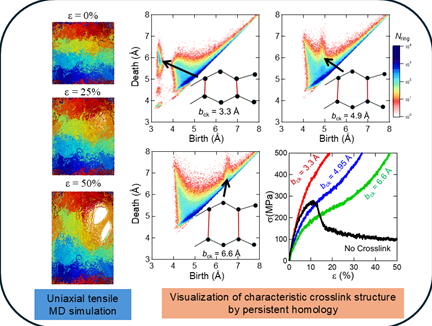
Overview of the Research Findings
A research team led by Assistant Professor Ryuhei Sato and Professor Yasushi Shibuta of the Graduate School of Engineering at the University of Tokyo, together with Researcher Shinya Kawakami of Nippon Paint Co., Ltd., used molecular dynamics simulations (Note 1) to analyze how the crosslinking structure of polymer coating films affects their strength.
In polymer films formed from waterborne paints, crosslinks between polymer chains play a key role in determining film strength. There is therefore a need for material design guidelines that enable efficient improvements in performance, based on a molecular-level understanding of the relationships among crosslinker type and amount, the resulting crosslinked structures, and coating-film strength.
The team simulated the tensile deformation of crosslinked polymer films. Within the systems studied, increasing the number of crosslinks improved resistance to deformation but had little effect on the initial elastic response. The results also suggest that multifunctional crosslinkers, which can connect multiple polymer chains, could provide effective reinforcement at lower crosslinker loadings.
To examine local structural changes, the team applied persistent homology (Note 2) to visualize changes associated with both crosslink formation and tensile deformation.
The findings are expected to deepen understanding of the relationship between the microscopic structure of polymer networks and their resistance to deformation, contributing to the development of paints with a lower environmental impact.
The findings were published in Macromolecular Theory and Simulations on October 26, 2026.
Research Details
In recent years, efforts to reduce environmental impact have accelerated the development of waterborne paints, which use less organic solvent. One way to control the strength and mechanical performance of coating films is to introduce crosslinked structures that chemically bond polymer chains together. However, the relationships between crosslinker type and amount, the resulting network structure, and the film’s mechanical performance are complex. Understanding how these networks respond to deformation at the molecular level is therefore essential for designing coating films with the required properties.
In this study, the team used coarse-grained molecular dynamics simulations (Note 3), in which each polymer chain is represented as a sequence of particles, to construct model coating films with different numbers of crosslinks and bonding structures. The researchers then simulated tensile deformation to examine how the polymer network structure influences the film’s stress response.
The simulations showed that increasing the number of crosslinks restricted polymer-chain motion and reorientation, increasing the network’s resistance to large deformations. In contrast, the number of crosslinks had only a limited influence on the stress response in the initial elastic regime (Figure 1).
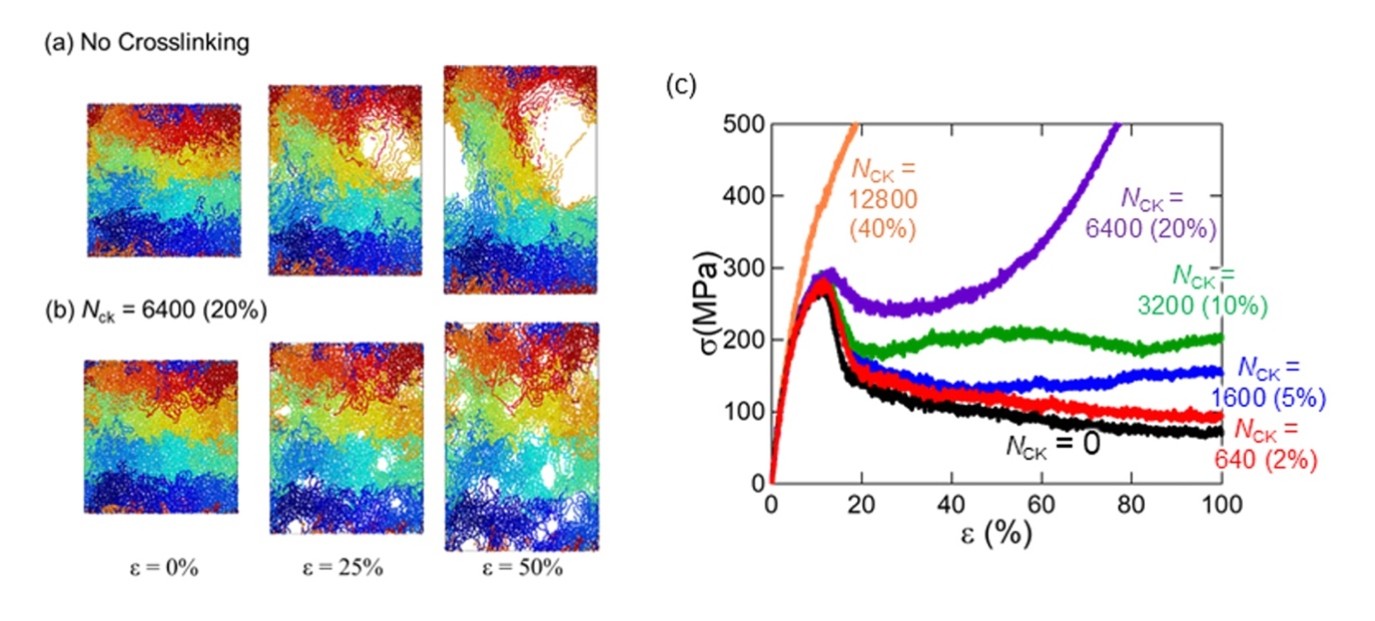
Panels (a) and (b) show simulated tensile deformation of films with no crosslinks and 6,400 crosslinks, respectively. Panel (c) presents the corresponding stress-strain curves (Note 4). Nck denotes the number of crosslinks in each film.
To examine how crosslink structure influences film deformation, the team analyzed models with different crosslink architectures (Figure 2). Within the systems studied, the deformation response depended more strongly on the total number of crosslinks than on the local bonding structure. Multifunctional crosslinkers, which contain multiple bonding sites, can form more crosslinks per molecule. The results suggest that these crosslinkers could help coating films achieve the required mechanical performance at lower crosslinker loadings.
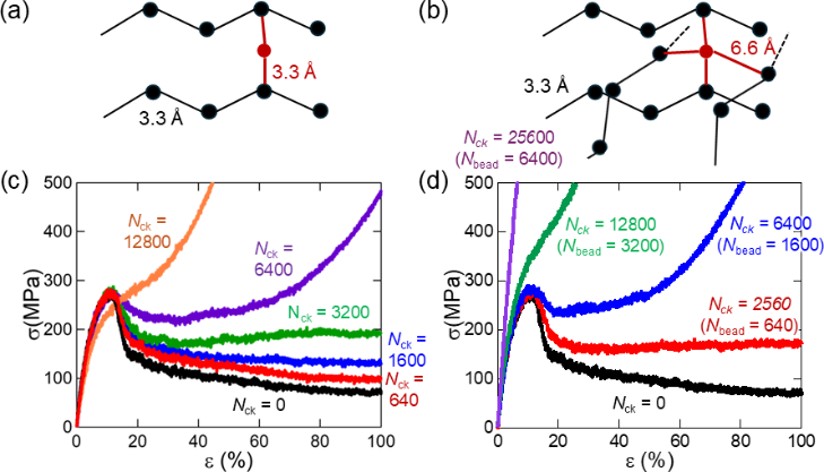
Panels (c) and (d) show stress-strain curves obtained from the tensile deformation simulations. Panels (a) and (b) schematically illustrate the crosslink architectures of the films analyzed in (c) and (d), respectively.
The team also applied persistent homology, a mathematical method for characterizing topological features, to analyze the polymer network. The analysis identified characteristic loop structures formed through crosslinking and tracked the stretching of some bonds within these loops during tensile deformation (Figure 3). These findings suggest that crosslinks constrain polymer-chain motion, concentrating deformation in specific regions of the network.
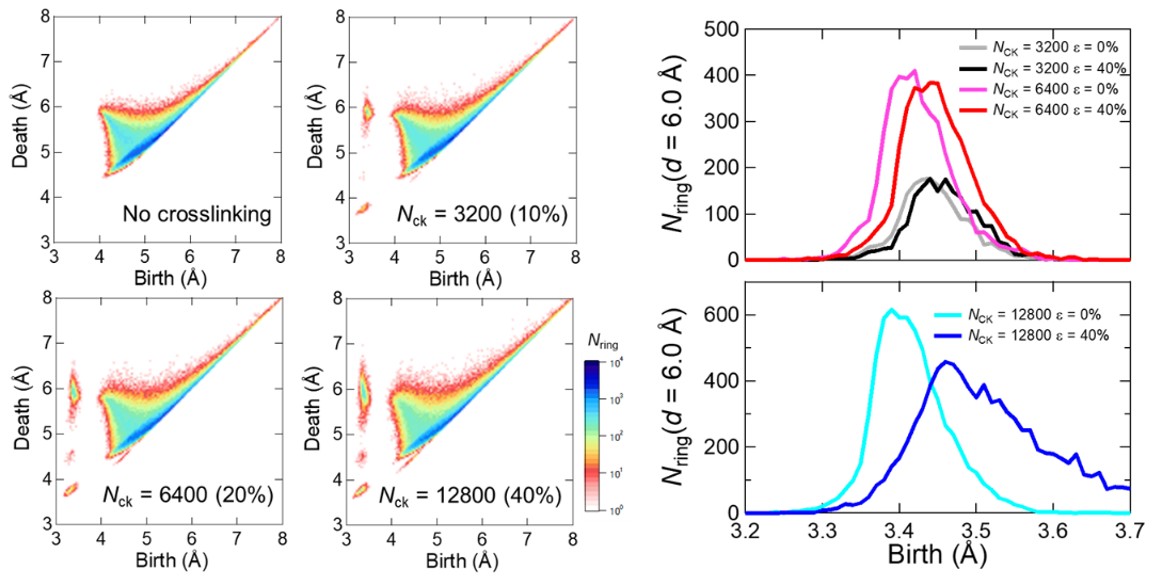
Left: Persistence diagrams characterizing loop structures in polymer coating films with different numbers of crosslinks. The diagrams provide an approximate representation of the distribution of loop sizes. Right: Distribution of changes in Birth— defined here as the minimum distance between particles within a loop —from the undeformed state (0% strain) to the deformed state (40% strain). The analysis focuses on crosslink-derived loops located near (Birth, Death) = (3.4, 6.0) in the persistence diagram.
These findings suggest that the mechanical performance of a coating film depends strongly on the overall crosslinked network, as well as on the molecular structure of the crosslinker. Future studies that account for crosslinking reactions in actual waterborne paints and heterogeneity within coating films are expected to lead to material design guidelines for achieving mechanically strong coating films using more appropriate types and amounts of crosslinkers
This study was conducted as a joint research project within the Social Cooperation Program “Creation of Innovative Coating Technologies,” established under an industry-academia co-creation agreement between the University of Tokyo and Nippon Paint Holdings Co., Ltd.
Authors and Researchers
Department of Materials Engineering, Graduate School of Engineering, The University of Tokyo
- Ryuhei Sato, Assistant Professor
- Yasushi Shibuta, Professor
Technology Division, Nippon Paint Co., Ltd.
- Shinya Kawakami, Researcher, Architectural Coatings Department
- Koichi Sato, Researcher, Division Director
Corporate R&D, Nippon Paint Corporate Solutions Co., Ltd.
- Satoshi Ishida, Researcher, Application Team
Publication Details
| Journal | Macromolecular Theory and Simulations |
|---|---|
| Article title | Coarse-Grained Molecular Dynamics and Persistent Homology Analysis of Crosslinker Effects on Polymer-Film Deformation |
| Authors | Ryuhei Sato*, Shinya Kawakami, Satoshi Ishida, Koichi Sato, Yasushi Shibuta |
| DOI | 10.1002/mats.70064 |
| URL | https://onlinelibrary.wiley.com/doi/10.1002/mats.70064 |
Glossary
- Note 1: Molecular dynamics simulation
A computational method for tracking the movement of atoms in a material by numerically solving their equations of motion. Given the forces acting on each atom and the initial positions and velocities of all atoms, their positions and velocities at any subsequent time are uniquely determined. - Note 2: Persistent homology
An analytical method based on mathematical topology that identifies structural features, such as loops and voids, in the spatial arrangement of particles. It visualizes and quantifies these features across different length scales and is used, among other applications, to analyze materials with disordered structures. - Note 3: Coarse-grained molecular dynamics simulation
A type of molecular dynamics simulation that reduces computational cost by representing groups of atoms as single particles. This approach is useful for studying large structures composed of many polymer chains and their deformation behavior. - Note 4: Stress-strain curve
A curve showing the relationship between stress and strain during a tensile test. It is used to determine a material’s fundamental mechanical properties, such as Young’s modulus and tensile strength.