
- Research and Development
- 2026.11.17
The University of Tokyo and Nippon Paint Jointly Develop a Model for Predicting the Environmental Impact of Coating Processes ― Enabling Assessments Prior to Equipment Installation and Supporting the Selection of Coating Methods ―
SHARE


November 17, 2026
Graduate School of Engineering, the University of Tokyo
Nippon Paint Holdings Co., Ltd.
The University of Tokyo and Nippon Paint Jointly Develop a Model for Predicting the Environmental Impact of Coating Processes ― Enabling Assessments Prior to Equipment Installation and Supporting the Selection of Coating Methods ―
Key Points
- Developed a model to predict the environmental impact of coating processes based on the dimension, weight, and surface area of the objects to be coated, together with factory operating conditions.
- A comparison of solvent-based, water-based, and powder coatings showed that powder coatings had the lowest greenhouse gas emissions and photochemical oxidant formation (Note 1), followed by water-based coatings and solvent-based coatings.
- The key factors influencing environmental impact varied by coating method: transfer efficiency (Note 2) and coated surface area for solvent-based and water-based coatings, and drying temperature for powder coatings. The model is expected to support assessments prior to equipment installation and the selection of coating methods.
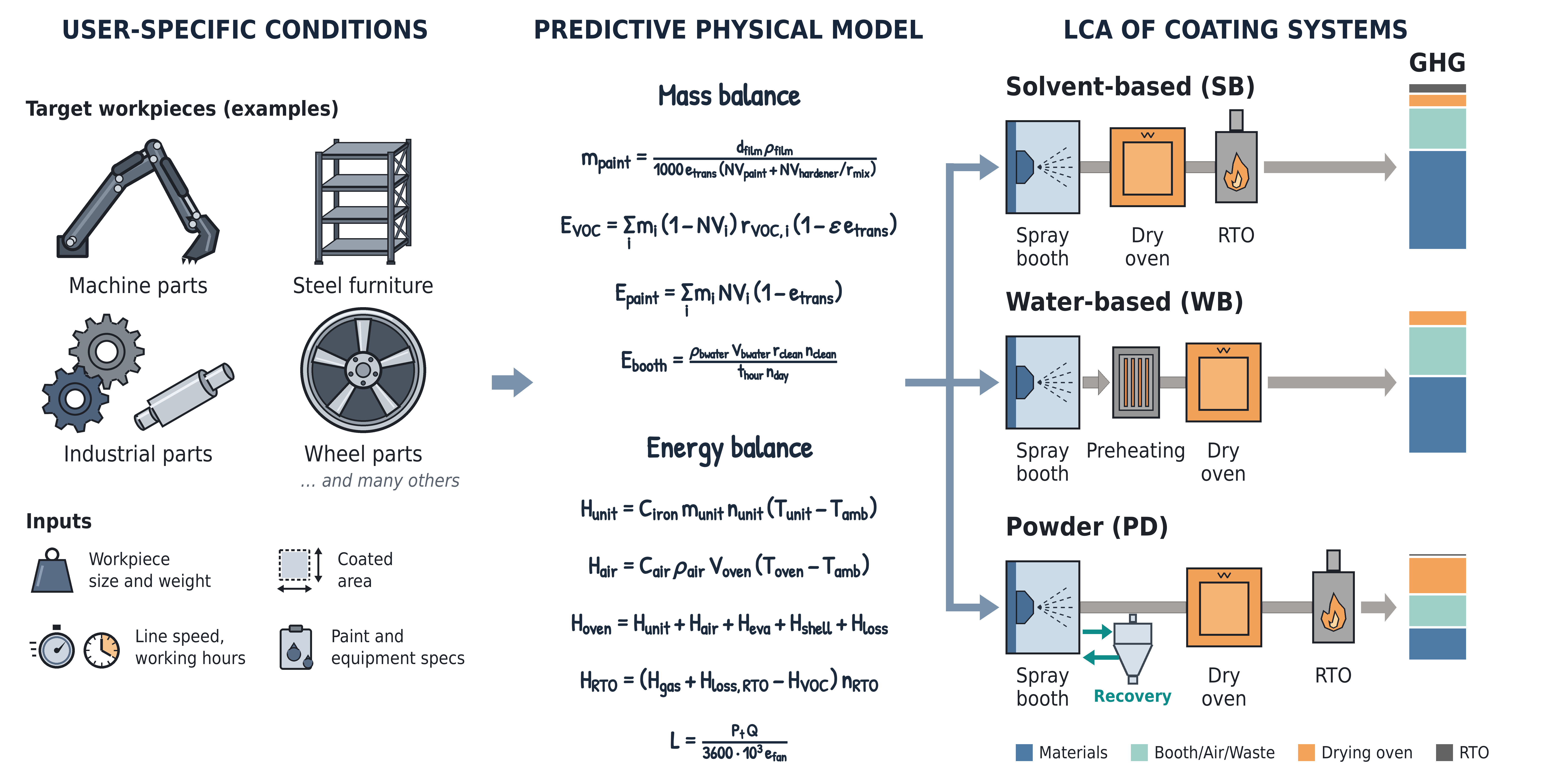
Overview of Research Findings
A research team from the University of Tokyo and Nippon Paint Corporate Solutions Co., Ltd., which supports the Nippon Paint Group’s domestic business operations and conducts R&D, has developed a model to predict the environmental impact of intermediate and topcoat application processes for industrial coatings under ser-specific conditions. General industrial coatings account for approximately 20% of the global coatings market, and most coating applicators are small and medium-sized enterprises. The characteristics of the objects being coated and the equipment used therefore vary considerably among businesses. Energy requirements for drying ovens and other equipment have traditionally been estimated on a case-by-case basis to determine equipment specifications. However, no model had previously been reported that comprehensively estimates material use, waste generation, and energy consumption for life cycle assessment (LCA; Note 3).
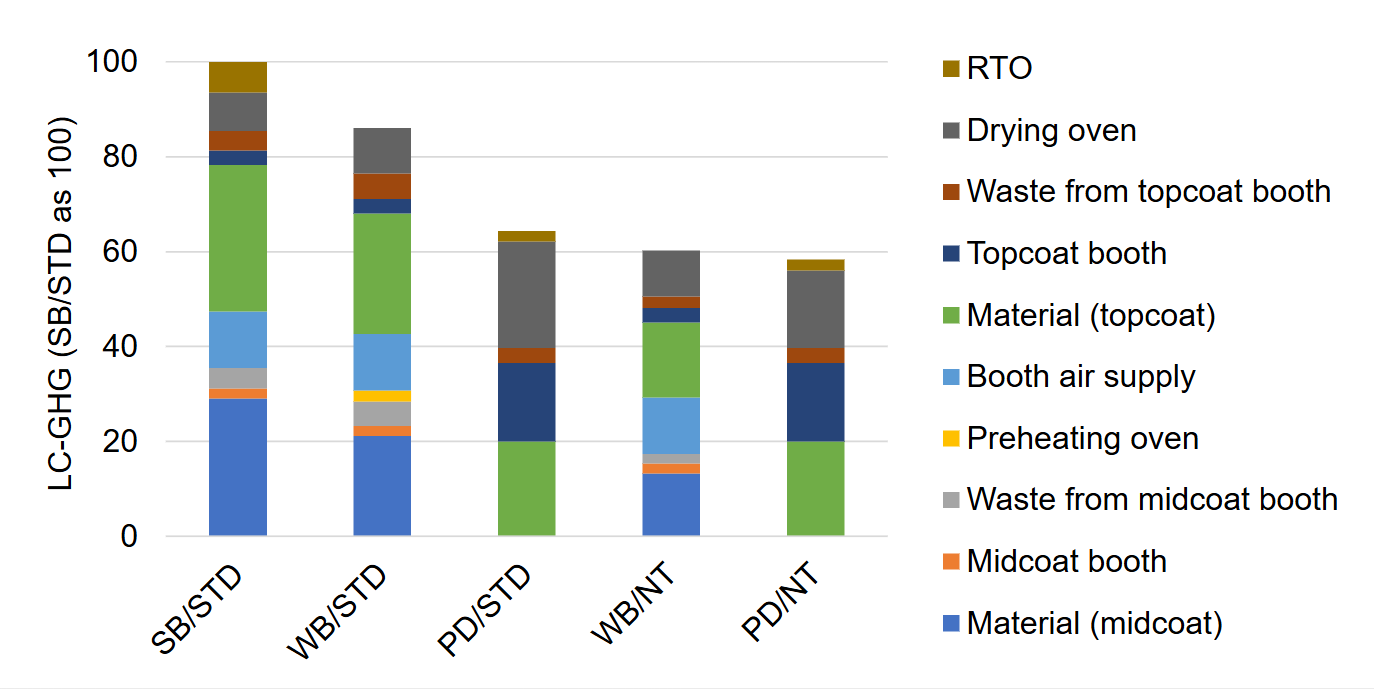
In this study, the researchers used equations based on mass and heat balances to calculate paint consumption, VOC emissions (Note 4), waste generation, and energy consumption in an integrated manner. A comparison of the three coating methods under standard conditions showed that greenhouse gas emissions were approximately 10% lower for water-based coatings and just over 30% lower for powder coatings than for solvent-based coatings (Figure 1). Photochemical oxidant formation was reduced by more than 70% for water-based coatings and was almost entirely eliminated for powder coatings. To identify opportunities for further reductions, the researchers evaluated scenarios involving improved transfer efficiency and the elimination of the preheating oven for water-based coatings, as well as lower-temperature curing for powder coatings. The results indicated that greenhouse gas emissions from water-based and powder coatings could be reduced to comparable levels (Figure 1). The model is expected to help companies compare and select coating methods with lower environmental impact before installing or upgrading coating equipment, and give impetus to the introduction of environmental measures on existing coating lines.
The findings were published on September 16, 2026, in Cleaner Engineering and Technology, a journal published by Elsevier, an international publisher based in the Netherlands.
Authors and Researchers
Yasunori Kikuchi, Professor, Institute for Future Initiatives / Department of Chemical System Engineering, Graduate School of Engineering, the University of TokyoTomohiro Kono, Researcher, Nippon Paint Corporate Solutions Co., Ltd.
Publication Details
| Journal | Cleaner Engineering and Technology, 34 (2026) 101320 |
|---|---|
| Article Title | A predictive life cycle assessment model for comparing industrial coating systems under user-specific conditions |
| Authors | Tomohiro Kono, Yasunori Kikuchi |
| DOI | 10.1016/j.clet.2026.101320 |
| URL | https://doi.org/10.1016/j.clet.2026.101320 |
Research Funding
This study was conducted as a joint research project under the Social Cooperation Program “Creation of Innovative Coating Technologies,” established through an industry-academia co-creation agreement between the University of Tokyo and Nippon Paint Holdings Co., Ltd. No external funding was received for this study.
Glossary
- Note 1. Photochemical oxidants:
Air pollutants formed when VOCs and other substances react in sunlight. These pollutants contribute to photochemical smog. - Note 2. Transfer efficiency:
The proportion of sprayed paint that adheres to the object being coated and forms a coating film. - Note 3. Life cycle assessment (LCA):
A method for quantitatively assessing a product’s environmental impact throughout its life cycle, from raw material sourcing and manufacturing to disposal. - Note 4. Volatile organic compounds (VOCs):
Organic compounds that readily evaporate into the atmosphere, including organic solvents used in paints.