
- Research and Development
- 2026.10.20
The University of Tokyo and Nippon Paint Develops New Method to Predict Color Development of Final Coating Film by Analyzing Liquid Paint ― Expected to Shorten Development Time, Reduce Costs, and Lower Environmental Impact ―
SHARE


October 20, 2026
Graduate School of Engineering, the University of Tokyo
Nippon Paint Holdings Co., Ltd.
The University of Tokyo and Nippon Paint Develops New Method to Predict Color Development of Final Coating Film by Analyzing Liquid Paint ― Expected to Shorten Development Time, Reduce Costs, and Lower Environmental Impact ―
Key Points
- Developed a new method to predict the color development of final coating film.
- The team also succeeded in selectively detecting the aggregation state of pigment particles in paints containing multiple components.
- The new method could eliminate the conventional need to produce a coating film before evaluating its quality. It is therefore expected to shorten development time, reduce costs, and lower environmental impact by decreasing material and energy consumption.
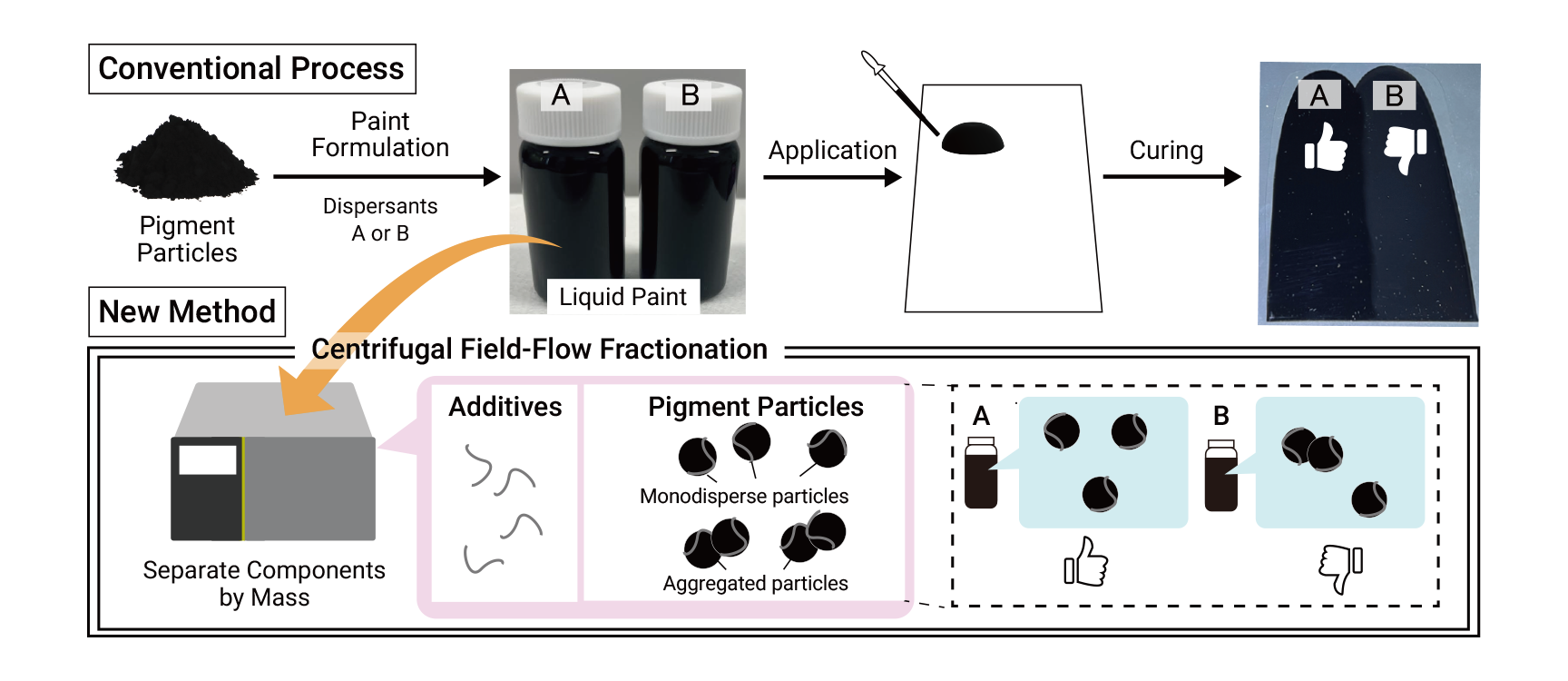
Overview of the Research Findings
A research team led by Associate Professor Seiichi Ohta of the Graduate School of Engineering at The University of Tokyo and researcher Shotaro Kobayashi of Nippon Paint Corporate Solutions Co., Ltd., which supports domestic business operations and R&D activities for the Nippon Paint Group, has developed a method for assessing the aggregation state of pigment particles in paint before coating film formation using centrifugal field-flow fractionation (Note 1).
The dispersion of pigment particles in paint significantly affects the color and appearance of the resulting coating film. However, because paint formulations contain various components, including resins and dispersants, selectively evaluating the aggregation state of the pigment particles themselves has been difficult. In this study, the team used centrifugal field-flow fractionation, a technique that separates particles based on differences in mass, to selectively assess the aggregation state of pigment particles even in complex paint formulations. The researchers also demonstrated that differences in pigment aggregation affect the jet-black appearance of the resulting coating film. This method enables the color development of the coating film to be assessed before film formation and is expected to streamline the production and evaluation of prototypes during paint development. It could consequently shorten development time, reduce costs, and lower material and energy consumption as well as waste generation.
The findings were published online in Langmuir, a journal of the American Chemical Society, on July 22, 2026 (local time).
Details of the Research Findings
Background
The dispersion of pigment particles in paint is a critical factor that significantly affects the color and appearance of the resulting coating film. Developing coating film with superior appearance therefore requires accurate evaluation of the aggregation state of pigment particles and appropriate optimization of the paint formulation. However, paint formulations contain various components in addition to pigments, including resins and dispersants. This has made it difficult to selectively identify pigment particles and directly assess their aggregation state. The conventional development process has consequently required researchers to repeatedly produce coating films, evaluate their color development, and modify the formulation based on the results. Because this iterative process requires considerable time and materials, a new method capable of evaluation the aggregation state of pigment particles before coating film formation has long been sought.
Research Method and Findings
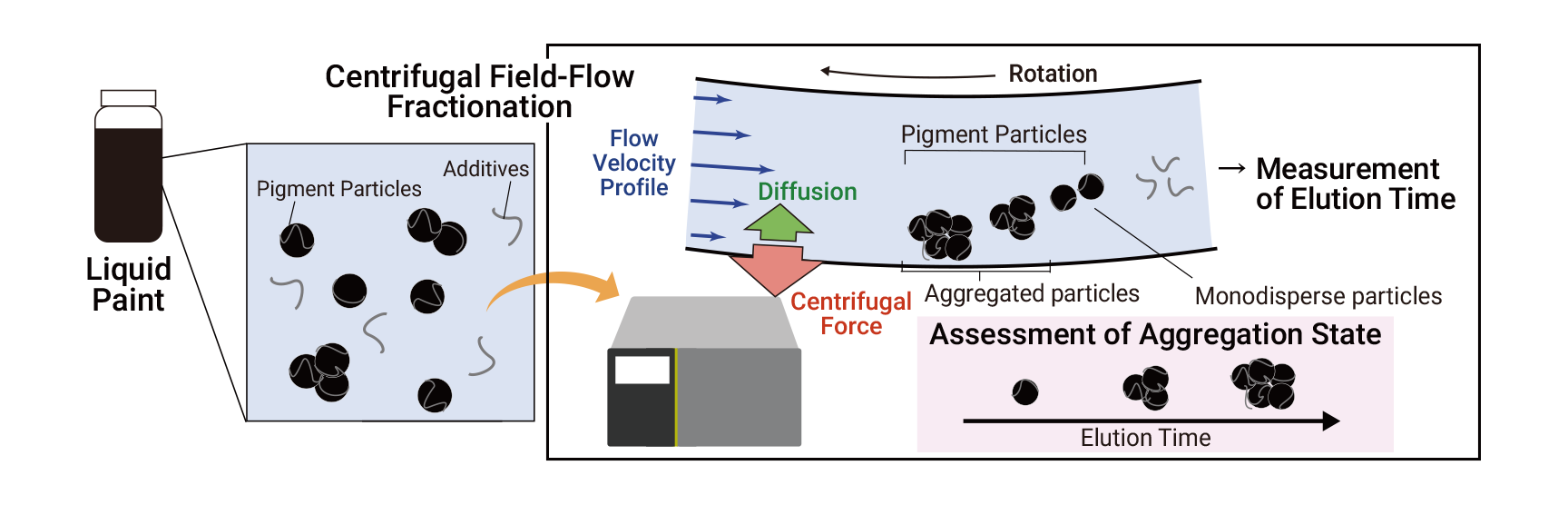
The research team successfully applied centrifugal field-flow fractionation, a technique that separates particles based on differences in mass, to selectively and sensitively assess the aggregation state of pigment particles in complex paint formulations containing multiple components, including resins and dispersants (Figure 1).
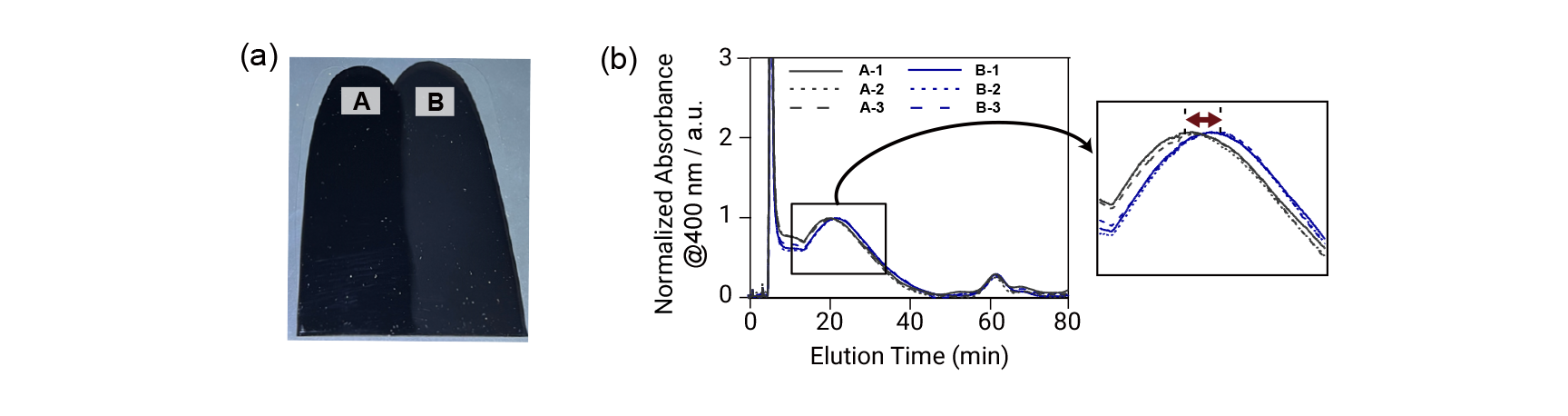
Carbon black (Note 2) is widely used as a pigment in black paints. Even when paints contain the same amount of carbon black, jet-black appearance of the resulting coating film can vary depending on the dispersant used (Figure 2a). However, the reason for this difference had not previously been identified. Dynamic light scattering (Note 3), a commonly used technique for evaluating particle aggregation, did not reveal a clear difference in the state of carbon black particles in two paints formulated with different dispersants. In contrast, centrifugal field-flow fractionation detected carbon black aggregation in the paint that produced a coating film with a weaker black appearance (Figure 2b). This aggregation was also confirmed using cryogenic transmission electron microscopy (Note 4), supporting the validity of the centrifugal field-flow fractionation results.
These findings demonstrate that the aggregation state of pigment particles―which affects the color development of the resulting coating film―can be assessed before film formation.
These findings are expected to contribute to the establishment of a new paint development process in which the color development of the coating film can be assessed directly from the paint before film formation. Reducing the number of coating film prototypes required would not only shorten development time and lower costs, but also decrease the consumption of paints and substrates, the energy used for drying and curing, and the amount of waste generated. The method could therefore improve the efficiency of paint development while reducing environmental impact and contributing to more sustainable manufacturing.
This research was conducted under one of the joint research themes of the social cooperation program “Creation of Innovative Coating Technologies,” established as part of the Industry-Academia Co-Creation Agreement between The University of Tokyo and Nippon Paint Holdings Co., Ltd.
Authors and Researchers
Graduate School of Engineering, The University of Tokyo
- Seiichi Ohta, Associate Professor
- Noriko Nakamura, Assistant Professor
- Ayaka Otsuka, Doctoral Student
- Hiroki Tsuchiya, Doctoral Student
Nippon Paint Corporate Solutions Co., Ltd.
- Shotaro Kobayashi, Researcher
- Ayako Iwakoshi, Researcher
Publication Details
| Journal | Langmuir |
|---|---|
| Article title | Sensitive Detection of Pigment Particle Aggregation in Paints via Centrifugal Field-Flow Fractionation |
| Authors | Ayaka Otsuka‡, Hiroki Tsuchiya‡, Noriko Nakamura, Shotaro Kobayashi, Ayako Iwakoshi, Seiichi Ohta* (‡ These authors contributed equally) |
| DOI | 10.1021/acs.langmuir.6c01568 |
| URL | https://doi.org/10.1021/acs.langmuir.6c01568 |
Glossary
- Note 1: Centrifugal field-flow fractionation
An analytical technique that separates particles according to differences in mass. Particles in a flow channel are subjected to centrifugal force and a perpendicular flow field, with particles of greater mass generally taking longer to elute. - Note 2: Carbon Black
Fine black particles composed primarily of carbon and widely used as a pigment in paints, inks, rubber, and other materials. - Note 3: Dynamic Light Scattering
A technique for measuring particle size by analyzing temporal fluctuations in the intensity of light scattered by particles moving in a liquid. In samples containing multiple components, distinguishing and evaluating individual components may be difficult. - Note 4: Cryogenic Transmission Electron Microscopy
An electron microscopy technique in which a sample is rapidly frozen and observed while its internal structure is preserved as closely as possible.