Font Size
Leadership Dialogue: NIPSEA China
Growing Against the Headwinds:
Disciplined “Share × Margin” Execution to
Deliver Profitable Growth
NIPSEA China’s competitive advantage lies in the discipline that holds firm not only in times of growth, but also through downturns. As China’s market structure undergoes significant change, NIPSEA China has stayed anchored to its disciplined “Share × Margin” execution, pursuing profitable growth across both the TUC (B2C business: business to consumers, DIY business, sales via dealers/distributors and e-commerce to end consumers, etc.) and TUB (B2B business: transactions direct to Project customers and main contractors, etc.) segments despite weak consumer sentiment and a sluggish property market. The objective is simple and consistent: grow share where it strengthens our competitive position, protect margins through value creation and cost discipline, and maintain financial resilience so that we can invest through the cycle. In this dialogue, we explore NIPSEA China’s ability to execute self-transformation and its long-term management philosophy grounded in a 10-year vision – autonomy, accountability, and MSV – covering topics ranging from sustaining top-of-mind awareness and creating demand, to expanding into Tier 3-6 cities, organizational transformation, and improving productivity through Digitalization and AI.
Executive Summary
Executive Summary
- 01
Protecting brand equity, preserving cash discipline, and keeping the organization ready to invest when opportunities appear is ultimately how we pursue MSV across cycles.
- 02
By combining innovation and service strategies, we are able to differentiate ourselves in a highly competitive market, and deliver sustainable results.
- 03
By tailoring our strategies to the specific needs and dynamics of each segment, we are able to respond more effectively to market changes and position NIPSEA China for continued success.
- 04
As competition intensifies, NIPSEA China’s color strategy plays a critical role in differentiating our brand and sustaining top-of-mind awareness.
- 05
Self-transformation is a core requirement for resilience, enhancing our ability to respond to changes in the business environment while protecting our capacity to invest through the cycle.
- 06
Looking forward with a ten-year perspective, NIPSEA’s unwavering commitment to the Chinese market and its disciplined “Share × Margin” execution will remain unchanged.
01
NIPSEA China’s Competitive Advantages
NIPSEA China’s Competitive Advantages
Built Over Time
Director, Representative Executive Officer
& Co-PresidentWee Siew Kim
& Co-PresidentWee Siew Kim
At the Nippon Paint Group, our unwavering mission is Maximization of Shareholder Value (MSV), and that mission applies consistently across all markets. In China, achieving MSV requires a very clear balance between growth and profitability. Over many years, NIPSEA China has demonstrated that sustainable performance comes from improving market share and margins together, rather than prioritizing one at the expense of the other. Even in a tough environment, the model remains replicable because it is anchored in discipline. It protects brand equity, preserves cash discipline, and keeps the organization ready to invest when opportunities appear, which is ultimately how we pursue MSV across cycles in China and beyond.
CEO of Nippon Paint ChinaEric Chung
China is an extremely competitive market, and growth without margin discipline is fragile. Volume gained at the expense of profitability is difficult to sustain and often damages brand value. NIPSEA China rejects a single price competition model and is driving the construction of a dual-engine model of “Innovation + Service.” This approach allows us to build a competitive moat that is not easily replicated, and puts us ahead of the competition.
Director, Representative Executive Officer
& Co-PresidentWee Siew Kim
& Co-PresidentWee Siew Kim
That is a great point, Eric. Could you walk us through how the “Innovation + Service” model is helping us stand out and deliver sustainable results in China’s competitive landscape?
CEO of Nippon Paint ChinaEric Chung
We are particularly proud of Magic Paint, which exemplifies our commitment to innovation. More than just a paint product — it delivers a distinctive style and aesthetic experience through finishes such as leather, fabric, micro-cement, and stone. By collaborating with aesthetic ambassadors and leveraging on our well-known IPs (such as our Dream Home Makeover TV programs, individual creative content, music), we are positioning Nippon Paint as the brand of choice for taste and expertise, enhancing our brand equity across all product categories.
On the service side, we focus on delivering a seamless end-to-end experience from product selection through to delivery. As early as 2011, NIPSEA China launched its Hassle‑Free Renovation Service, or “No-Need-to-Lift-a-Finger” renovation service system, which was further enhanced under our 2025 strategic blueprint. By leveraging a growing network of community stores, we bring decision-making closer to consumers, convenience and encourage repeat purchases. As of end-2025, 300 NIPSEA China community stores had been rolled out nationwide. In 2026, Nippon Paint will roll out a community store upgrade program, strengthening the reliability of its “last‑mile delivery” through enhancements to store image, product offerings, and operating models. In parallel, we have set industry benchmarks through our talent certification system, ensuring that skilled applicators are trained to our standards. This not only builds trust but reinforces NIPSEA China’s reputation for quality craftsmanship.
Together, these innovation and service strategies help us stand out and deliver sustainable results, even in a highly competitive market.
02
Navigating Through a Changing Market
Director, Representative Executive Officer
& Co-PresidentWee Siew Kim
& Co-PresidentWee Siew Kim
China’s economy achieved a steady and resilient expansion and is navigating a significant transformation within the housing and property markets. NIPSEA China monitors these trends and adjusts its strategic priorities to maintain resilience and capitalize on emerging opportunities.
CEO of Nippon Paint ChinaEric Chung
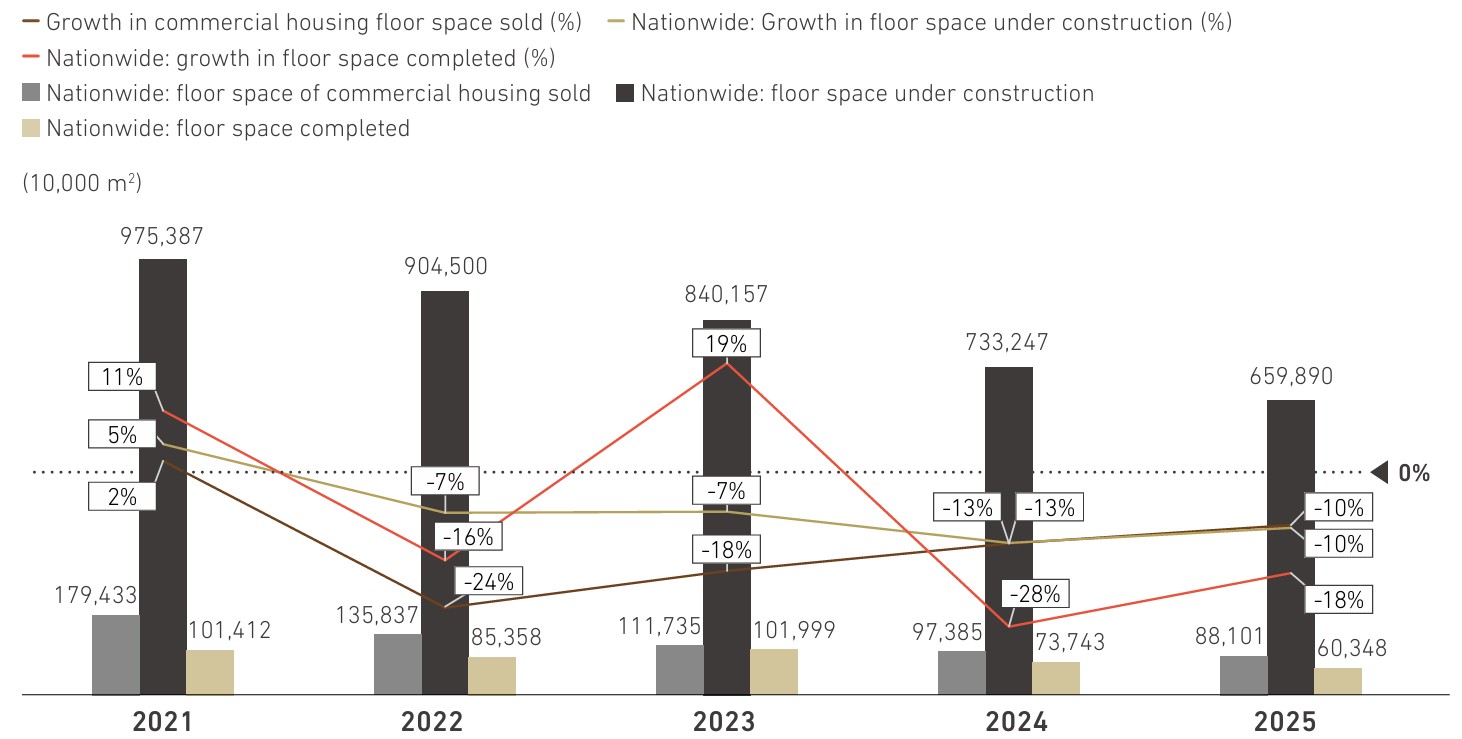
According to the National Bureau of Statistics of China, floor space under construction by real estate developers declined by 10%, while completed floor space fell by 18% in 2025. Despite these industry headwinds, NIPSEA China’s revenue performance in 2025 demonstrated greater resilience, with revenues declining less than the broader industry average. This outperformance underscores the effectiveness of its strategic initiatives and its ability to adapt in a challenging environment.
Director, Representative Executive Officer
& Co-PresidentWee Siew Kim
& Co-PresidentWee Siew Kim
A key factor behind this resilience is our differentiated approach for the TUC and TUB segments. By tailoring our strategies to the specific needs and dynamics of each segment, we are able to respond more effectively to market changes and position NIPSEA China for continued success.
CEO of Nippon Paint ChinaEric Chung
NIPSEA China’s TUC strategy is centered on capturing growth in Tier 3-6 cities and expanding its texture coatings portfolio. The company has adopted an asset-light approach to enable rapid expansion into the smaller cities. A key component of this approach is the Application Service Partner model, which builds direct service relationships with painters and accelerates penetration in these markets. County distributors support service providers, allowing them to focus on customer acquisition and delivery, which ensures efficient distribution and quality service.
More than 12 million people have returned or moved to rural areas, driving demand for houses there. In 2025, government subsidies for rural revitalization totaled RMB 159.3 billion. Rural housing construction has shifted from basic shelter to decorative and functional needs, with residents seeking to live well. NIPSEA China’s texture paint strategy addresses these upgraded demands and needs by offering competitive and broad-range products tailored for rural markets. Enhanced production efficiency and price competitiveness make texture coatings accessible and attractive in these regions. NIPSEA China’s TUC strategy enables the company to gain ground and deliver resilient performance, even as the broader market continues to face headwinds.
Director, Representative Executive Officer
& Co-PresidentWee Siew Kim
& Co-PresidentWee Siew Kim
Some investors continue to associate TUB through the lens of the property cycle. The more important consideration, however, is how the business is actively repositioning itself, rather than waiting for a recovery in the residential construction.
CEO of Nippon Paint ChinaEric Chung
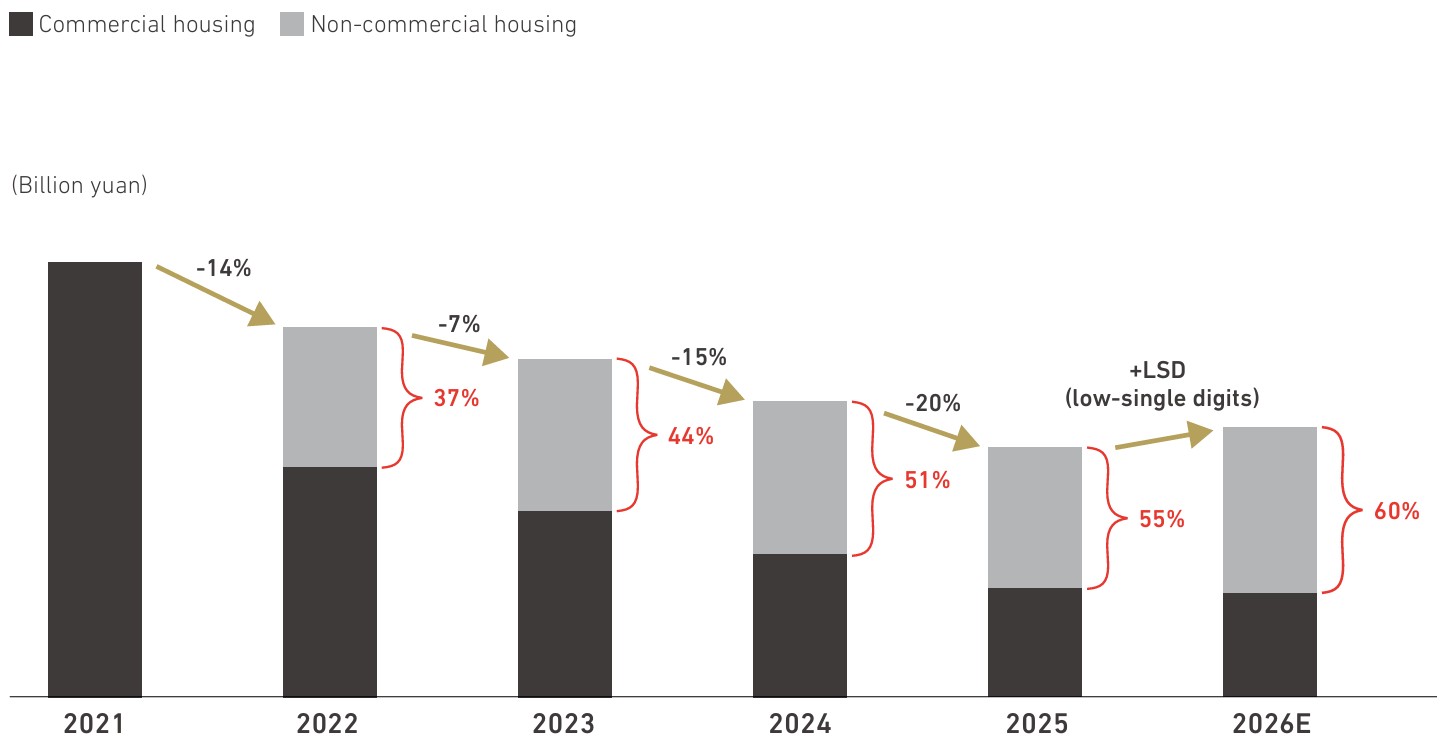
TUB is undergoing a significant transformation. The slowdown in residential construction has accelerated our shift toward industrial and infrastructure-related projects. In these areas, technical capability, service quality, and reliability are paramount, outweighing price competition. We are focusing on project types where we can demonstrate differentiated performance, deliver on time, and manage risk effectively. This approach not only improves margin quality and reduces exposure to cyclical residential demand, but also enforces stronger project selection discipline and tighter credit controls. Since 2021, the proportion of non-commercial housing tracks—including industrial enterprises, municipal engineering, heavy industry, hotels, and commercial complexes—has gradually increased to over 50% of overall TUB business, and is expected to rise further to 60% by 2026. This strategic shift is establishing a stronger foundation for TUB’s long-term growth in a changing market environment.
Sales, Construction, and Completion Areas of Commercial Housing by Real Estate Developers, and Their Growth Rates (2021–2025)
TUB Net Sales and Business Structure (2021–2026E)
03
Brand Strength and Demand Creation
Director, Representative Executive Officer
& Co-PresidentWee Siew Kim
& Co-PresidentWee Siew Kim
NIPSEA China’s strong brand is a critical driver of demand creation. By maintaining top-of-mind awareness and a premium brand image, the company ensures it is the first choice for consumers at the point of purchase. This is achieved through consistent investment in brand building and channel development.
CEO of Nippon Paint ChinaEric Chung
Over the past three decades, NIPSEA China has consistently invested in building and strengthening our brand image, recognizing the importance of brand awareness in a highly competitive paint market. As a result, we have sustained a top-of-mind awareness rate of over 50%, representing an absolute advantage which is roughly twice that of competitors.
Our brand communication strategy is multi-faceted, including a longstanding collaboration with the TV program Dream Home Makeover which has been running for 11 consecutive years, embedding the brand’s image of revitalizing beautiful living spaces in consumers’ minds. We have promoted color expertise and established NIPSEA China as a leader in wall color trends, culminating in the launch of the “Magic Paint” series in 2022 and the introduction of a brand ambassador to lead the new trend of textured paint.
Director, Representative Executive Officer
& Co-PresidentWee Siew Kim
& Co-PresidentWee Siew Kim
Color is at the heart of how we connect with our customers. As competition intensifies, our color strategy plays a critical role in differentiating our brand and top-of-mind awareness. By offering a broad and trend-led color palette, we enable consumers to easily find options that fit their style.
CEO of Nippon Paint ChinaEric Chung
Our color strategy is multi-layered. First, we use data from our computerized color matching (CCM) tinting machines to understand what colors are trending in different regions, among different age groups, and at different times of year. This helps us stay ahead of the curve and tailor our offerings to what people actually want. We also run annual color trend reports and work with influencers on social media to promote popular colors especially on platforms like Rednote (Xiaohongshu), where we are ranked #1 for color. For more conservative customers, we recommend classic, versatile colors and provide easy-to-use matching formulas, supported by offline sales training and optimized store displays.
We have introduced AI tools to generate high-quality case materials and offer interactive color selection through our WeChat mini program. We create immersive color-themed spaces at major design exhibitions and partner with top art museums to enhance our brand’s appeal, especially among younger audiences. All these efforts culminate to make our color strategy a real driver of demand and a key part of our brand strength.
04
Self-Transformation and Productivity Improvement
Director, Representative Executive Officer
& Co-PresidentWee Siew Kim
& Co-PresidentWee Siew Kim
Beyond front-end growth, productivity improvement and risk management are also critical, particularly in a volatile environment. From a group standpoint, self-transformation is not optional. It is a core requirement for resilience, and it protects our capacity to invest through the cycle.
CEO of Nippon Paint ChinaEric Chung
Over the past few years, we have driven significant organizational transformation, including the implementation of IPD (Integrated Product Development) and PDT (Product Development Team). We have established a platform‑based organizational model that seamlessly connects the front, middle and back offices to enable end‑to‑end collaboration. Our front office is sharply focused on key industries and customers, with a clear emphasis on understanding and capturing customer value. The middle office is centered on profit delivery and capability building, particularly through product and technology innovation, enabling us to develop differentiated solutions that truly stand out in the market. Meanwhile, our back office has built integrated service capabilities that keeps the whole organization running efficiently and cohesively.
Director, Representative Executive Officer
& Co-PresidentWee Siew Kim
& Co-PresidentWee Siew Kim
Investors increasingly ask about risk resilience in China. How does NIPSEA China ensure that we have the right controls, and that problems are surfaced and tackled early?
CEO of Nippon Paint ChinaEric Chung
We have strengthened processes in credit evaluation and management, especially for businesses within real estate. Our system now proactively identifies credit and liquidity risks for specific companies, enabling us to act before issues escalate. By establishing a coordinated approach across Legal, Finance, and Business, we ensure credit and default risks are addressed promptly and comprehensively. This helps us surface potential problems early and maintain a robust risk control environment.
Director, Representative Executive Officer
& Co-PresidentWee Siew Kim
& Co-PresidentWee Siew Kim
Globally, digitalization and AI are transforming the coatings industry by enabling smarter manufacturing, predictive maintenance, advanced quality control, and personalized customer experiences. Companies that embrace these technologies are better equipped to drive innovation, achieve operational excellence, and meet the rising expectations of customers and regulators.
CEO of Nippon Paint ChinaEric Chung
NIPSEA China’s digitalization and AI strategy is centered on driving a “Data-flow integration + AI-driven” transformation. To ensure effective implementation, the Transformation Committee oversees strategic planning and decision-making, while cross-departmental working groups and consensus meetings facilitate project execution. The company has established an empowerment system for all employees, focusing on AI talent development, and conducts regular surveys and reviews for continuous optimization.
Some examples of AI projects include TUC’s AI Design application, which allows rapid generation of wall renderings and 3D videos within two minutes, TUB’s AI Intelligent Delivery Assistant reducing manual order processing rate and exceptional handling times, and a new “Hundred Cities, Thousand Stores” initiative to empower stores to upgrade from selling products to selling services.
05
Continued Sustainable Growth
Director, Representative Executive Officer
& Co-PresidentWee Siew Kim
& Co-PresidentWee Siew Kim
Looking forward with a ten-year perspective, NIPSEA’s unwavering commitment to the Chinese market and the approach of disciplined “Share × Margin” execution will remain constant.
CEO of Nippon Paint ChinaEric Chung
NIPSEA China will maintain its focus on the business principle of “Share × Margin.” In response to a high-quality economic transformation and global structural reshaping, the company will advance core strategies including innovation-driven growth, service enhancement, intelligent manufacturing, flexible delivery, organizational transformation, efficiency improvement, technology leadership, AI empowerment, and sustainable development. By leveraging technology, NIPSEA China aims to build a value-driven ecosystem platform and strengthen its leadership in comprehensive coating solutions.